In the US, German is considered a “foreign” language. Ever since I started studying and teaching the German language and literature in this context, my guiding principle has become to question our ideas about the “foreign” versus the “national” in my classrooms. This critical principle is informed by my diverse teaching experience comprising students of all levels of German at Columbia University, high school girls in India, literary studies students in Estonia, adult heritage speakers in New York and Undergrads in Germany, as well as grading and editing academic work as a research assistant for various professors on both sides of the Atlantic. Based on these encounters, the guiding principle of my teaching has become to empower students to own and shape the language and culture, inviting them for a deep, sincere and critical engagement with it. In my selection of material, assignment, syllabus and assessment design, I am committed to challenging the stereotypical native speaker paradigm with my students in order to contribute to diversifying German(y) together.
A first necessary condition for students to own and change the language by bringing in their singular personal selves is their insight in the flexibility and sociality of language. Therefore, my German language classes happen in German, except for very complex grammar confusion requiring clarification in English or moments of collective reflection on a ‘hot’ cultural topic that might trigger students personally, like racism or sexism. Often, students struggle with the German language as they get frustrated with grammatical complexities and their wish to speak perfectly, aiming for a native speaker standard. This frustration is a logical result of being confronted with exclusively standard high German material, which has long been the default case in the German classroom. To counter such frustration while also maintaining a high standard of grammatical correctness, I regularly do collective translation exercises with my students. Translating short snippets of the same text in different groups, students realize in their presentations that there are always different ways to translate and express something. They also realize that speaking is a social happening – and that what one says how depends on with whom one speaks. For instance, in my Intermediate Conversation class, we translated Kant’s ‘Categorical Imperative’ to three different English versions. While Kant’s German would have been too difficult for most students individually, they collectively were able to crowd source their skills and create highly complex group translations. Comparing their translations together on the board, I could discuss grammatical mistakes without cold-calling and isolating individual students. All groups excitedly realized how much they learned from the other groups and were proud to have collectively mastered such a seemingly complicated passage – one which most of them already encountered as a famous piece of enlightenment in their Core Curriculum classes.
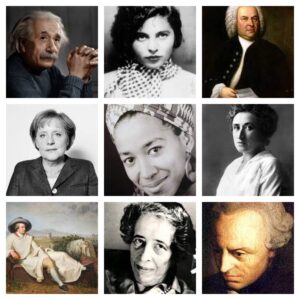
While addressing the canonical helps students connect to the ‘foreign’ language – one which many students know very little about except for “Mozart” or maybe “Goethe” – my courses seek to diversify the German curriculum in order to enable students to imagine their own selves as part of it by reflecting on how they adopt and adapt the language and its tradition. The German canon is mostly male and white which can be alienating to many people with other identities. To increase the representativeness of the canon of Germany’s diverse population and offer more potential points of connections for a diverse student body, my classes prominently feature authentic material by structurally marginalized groups in Germany like Black Germans, Women, Jews or Muslims. For instance, in my first self-designed class on Women Poetry, we discussed work by Black poets and Kurdish rappers. Further, I designed a handout which I distribute in the first session along with the syllabus and which invites students to reflect on how the material listed in the syllabus matches their own expectations and what they were missing. In two group presentations at the end of the poetry class, students were invited to bring in their own (German-related) material and lead a whole class session on this material. Under my guidance, students thus participated in shaping the class content and define their way of engagement with it. One group designed a highly complex, unforgettable ‘Jeopardy’ game on German migrant rap music and its problematic, yet also revolutionary chauvinism and sexism.
Owning the German language and culture in the twenty-first century means to be able to navigate Germany online. Not only since the recent pandemic, we live in an essentially hybrid mode, constantly oscillating between physical and metaverse realities. In my classes, I seek on the one hand to take advantage of the increased proximity of German(y) by integrating the digital world. On the other hand, I invite students to use technology mindfully as they have been increasingly struggling to concentrate as opportunities for distraction accumulate. Most of my homework assignments and assessments are located online. Most students submit papers and revisions through google docs (except if students need other accommodations), where I can line edit and comment on their work so that they can pose questions on my comments and track their process smoothly and in one place. Our online platform is not only the space for asynchronous work but also for synchronous research exercises in the classroom in selected sections of the class. Outside these designated activities, technological devices are not allowed as I invite students to be present wherever we are together, demonstrating their active listening or contributing in reality or online.
To increase students’ ability to focus on complex material, my classes always include at least one in-depth close reading training with each individual student. While we practice such close reading regularly together in class, the individual sessions are part of the concluding course assessment, along with a written personal reflection on the learning process. Thus, I invite students to recapitulate their learning process – thinking back to the intentions they set for the class in the beginning (in a respective online assignment targeting meta-cognitive awareness and their personal motivation). The live close readings intend to deepen students’ individual ideas about the material and practice articulating them orally in a live conversation. As I noticed that many students would like to express their opinion but often struggle to find the right words spontaneously, especially in German, I decided to give each student the chance to engage with known material in their own way with no one present but me. Thus, I hope to counter students’ tendency to hide behind the most eloquent person in the class in interpretative group discussions. I never learned as much about students’ thoughts and skills as in those time-intensive sessions. The grading makes only a small percentage point in the overall summative assessment which is meant to allow students to conclude the course with a boost in confidence.
Developing diverse senses of German languages and cultures together with students of German has become my primary endeavor. When students leave my classes, I want them to feel empowered to create their own (personal or professional) identities in German, thus contributing to shaping the language and culture by communicating themselves in it. I want students to be able to articulate and share their own ideas of what German is and what it means to speak it – in German.
